An important part of GCIEL activity is to research how immersive environments can support teaching and learning, and to articulate best practices for their use at liberal arts colleges. Below is a growing list of research that has emerged from lab activity. Please let us know if you are interested in presenting a paper on your experiences with immersive environments, would like to explore how immersive environments could benefit your field with a research article, or would like to publish findings on research you have done. We would be happy to step you through the process, connect you with relevant research, and work on developing the paper with you.
VR Experiences
The Virtual Viking Longship Project
This project explores and tests strategies for integrating and fairly compensating undergraduate student learning and labor in the development of long-term digital humanities research projects. Combining the strengths of two leading liberal arts colleges with the multidisciplinary affordances of virtual reality (VR) technologies, the project aims to create an immersive VR experience for visualizing the social and cultural roles of a Viking Age longship by forming a DH community of inquiry and practice that cultivates deep competencies in spatial computing within the context of a liberal arts education.
Android APK file (sideload with SideQuest)
The German Environmentalism VR Project
Expanding the scope of the original flat screen 3D game, which introduced players to glass recycling and waste management systems in German public spaces, this VR experience will include more narrative to situate the user in authentic German cultural situations and more in-game tasks related to recycling and waste management practices. The project will determine whether increased immersion and sense of presence in a completely virtual environment can target greater learning outcomes in second language and culture acquisition, and perhaps even realize outcomes that were not discovered in the 3D version of the game.
Envisioning Heorot VR Project
Continuing the work of The Grinnell Beowulf, the project will construct a VR simulation of Heorot based on archaeological excavations of Viking meadhalls in Denmark and England, particularly the hall at Lejre, as well as accounts from historical and poetic records from the early Middle Ages. The project will help modern readers of Beowulf to better understand the civic spaces that helped shape the poem’s social structures, allowing them to see how the layout of the hall contributes to its function as a political and social arena.
Grant Awards
The Virtual Viking Longship Project: A Study in the Future of Liberal Arts Teaching and Research, $46,135 USD. Neville, D. (PI), Arner, T. (Co-PI), Mason, A. (Co-PI). Digital Humanities Advancement Grant (Level I), National Endowment for the Humanities, 2023.
The Grinnell College Immersive Experiences Lab (GCIEL), $144,000 USD. Neville, D. (PI) & Kelty-Stephen, D. (Co-PI). Innovation Fund (Pilot Project), Grinnell College, 2017.
The Grinnell College Immersive Experiences Lab (GCIEL), $10,000 USD. Neville, D. (PI) & Kelty-Stephen, D. (Co-PI). Innovation Fund (Planning Project), Grinnell College, 2016.
Proposed Grants
Developing Cultural and Linguistic Competencies Through Virtual Reality, $49,041 USD. Neville, D. (PI), Frances, C. (Co-PI), Kelty-Stephen, D. (Co-PI), Larson, J (Co-PI), Phillips, N. (Co-PI), Preast, V. (Co-PI). Digital Humanities Advancement Grant (Level I), National Endowment for the Humanities (NEH), 2018.
Publications
Neville, D., Preast, V., Purcell, S., Kelty-Stephen, D., Arner, T., & French, C. (2020). Using virtual reality to expand teaching and research in the liberal arts. Journal of Interactive Technology and Pedagogy, Issue 17.
Ramey, L., Neville, D., Amer, H., deHaan, J., Durand, M., Essary, B., Howland, R., Kapadia, M., Kronenberg, F., Shelton, B., & Vance, B. (2019). Revisioning the Middle Ages: Immersive environments for teaching medieval languages and culture. Digital Philology: A Journal of Medieval Cultures, 8(1), 86-104.
Yao, S., Queathem, E., Neville, D., & Kelty-Stephen, D. (2018). Teaching movement science with full-body motion-capture in an undergraduate psychology class. Research in Learning Technology, 26.
Neville, D. (2019). Enhancing the liberal arts with extended reality. University-Industry Innovation Magazine, 2, 28-31.
Georgieva, M., Craig, E., Pfaff, D., Neville, D., & Burchett, B. (2017). 7 Things You Should Know About AR/VR/MR. Washington, DC: EDUCAUSE Learning Initiative (ELI).
Presentations
Neville, D., Arner, T., & Mason, M. (2021, May). The virtual Viking longship project: A study in the future of liberal arts teaching and research. Paper presented at the Emerging Technologies for Education Conference 2023, Lindenwood University, Online.
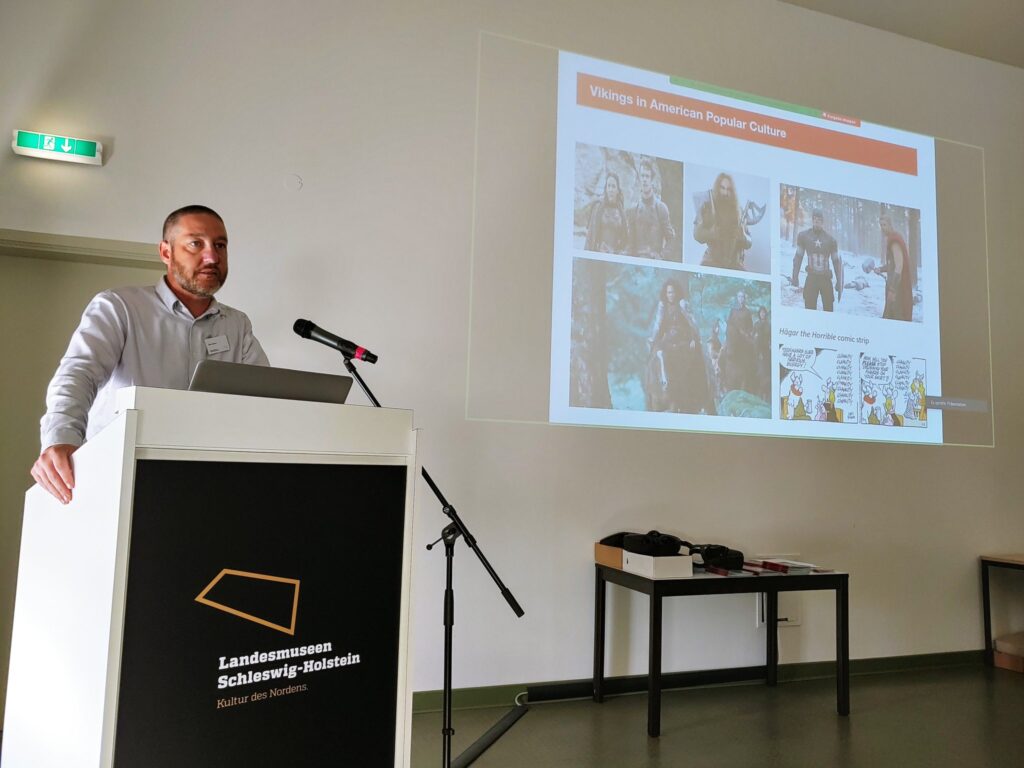
Neville, D., Arner, T., Mason, A. (2022, October). Reimagining the Viking legacy in virtual reality: Race and representation in America’s Viking past. Stiftung Schleswig-Holsteinische Landesmuseen Schloss Gottorf, Schleswig, Germany.
Neville, D. (2021, October). VR for the liberal arts: The Grinnell College Immersive Experiences Lab (GCIEL). Presentation and Panel Discussion, Kenyon College, Gambier, Ohio.
Neville, D. (2021, July). Teaching the medieval in the digital age: A round table discussion. International Medieval Conference, University of Leeds, Online.
Arner, T. & Neville, D. (2021, July). The VR Beowulf project: Visiting Heorot. Paper presented at the International Medieval Conference, University of Leeds, Online.
Neville, D., Arner, T., & Mason, M. (2021, May). The virtual Viking longship project: A study in the future of liberal arts teaching and research. Paper presented at the Day of Digital Humanities 2021, Carleton College, Online.
Neville, D., Arner, T., & Mason, M. (2021, May). The virtual Viking longship project: A study in the future of liberal arts teaching and research. Project presented at the 7th International Conference of the Immersive Learning Research Network, Immersive Project Showcase and Competition, iLRN Virtual Campus, Online.
Neville, D. (2020, April). The experience curriculum: Immersive realities for teaching and research in the liberal arts. Presentation at the Digital Humanities, Immersive Realities Workshop, Lindenwood University, Online.
Arner, T., Thomas, J., & Neville, D. (2019, December). The Viking meadhall project. Poster presented at the Teaching with Technology Fair, Grinnell College, Iowa.
Neville, D. (2019, July). Designing and developing VR experiences: A liberal arts approach. Paper presented at the Associated Colleges of the Midwest Summer Workshop on 3D/VR/AR, Grinnell College, Iowa.
Kelty-Stephen, D. & Neville, D. (2018, May). Grinnell College’s Immersive Experiences Laboratory (GCIEL): Using virtual reality to promote interdisciplinary collaboration in the liberal arts. Presentation at the ELI Online Event | eXtended Reality (XR): How AR, VR, and MR are Extending Learning Opportunities.
Nakahira, S., Segall, Z., & Swoap, R. (2018, April). Visualizing difficult historical realities: The Uncle Sam Plantation project. Poster presented at Research, Scholarship, and Creative Activity Symposium. Grinnell College, Iowa.
Neville, D. (2018, April). Virtual reality for the liberal arts and social good. Presentation at the HackGC Conference. Grinnell College, Iowa.
Purcell, S. & Neville, D. (2017, December). The Uncle Sam Plantation project. Poster presented at the Digital Liberal Arts Fair, Grinnell College, Iowa.
Neville, D. & Purcell, S. (2017, November). Visualizing difficult historical realities: The Uncle Sam Plantation project. Poster presented at the Humanities, Arts, Science and Technology Alliance and Collaboratory (HASTAC) Conference: The Possible Worlds of Digital Humanities, Orlando, Florida.
Neville, D. (2017, April). Ab in die Zukunft! Blended learning and immersive environments for German language and culture instruction. Presentation at the Iowa American Association of Teachers of German (AATG) Spring Meeting. Grinnell College, Iowa.
Neville, D. (2016, December). Using a self-designed video game to improve writing outcomes. Paper presented at the Immersive Environments Colloquium, Vanderbilt University, Tennessee.
Neville, D. (2016, December). Creating language learning games for the classroom. Paper presented at the Immersive Environments Colloquium, Vanderbilt University, Tennessee.
Neville, D. (2016, June). The Uncle Sam Plantation: A 3D/VR learning environment for teaching lost and difficult histories. Paper presented at the National Endowment for the Humanities (NEH) Advanced Challenges Summer Institute on Theory and Practice in 3D Modeling of Cultural Heritage Sites, University of California – Los Angeles.
Anger, J., Neville, D., & Rennick, R. (2015, January). 3D visualization of historic art exhibition: The First German Autumn Salon, Berlin, 1913. Paper presented at the 9th Annual Campus Academic Strategies and Technology (4CAST) Event (Bridging Art and Science: STEAM Education in a Digital World), University of Iowa.
